
Deities and Faiths
The entries presented below reflect the most common ways of referring to each known god rather than intimate personal knowledge of said god; as such, it is very much possible that these accounts differ from reality.
The Nature of Gods, Celestials, and Fiends
Gods within the Firmament take a different form to those in traditional Pathfinder/D&D/similar settings. Gods are not inherently tied to celestials or fiends - though some choose to keep them as allies - and are generally less likely to directly intervene in the affairs of mortals. Rather, gods have their own agendas that they enact, along with myths and legends that follow them. Gods have worshippers and cults, and gods choose clerics and champions just as in other settings, but encountering a god's chosen is much less common, and most who serve in churches or temples have only ceremonial or ritual power.
Gods always come from something else in the world of the Firmament, sharing a commonly mortal ancestry. In addition, few who desire godhood ever reach it, and the secretive and esoteric processes of attaining godhood are likely to come only to those passionate about a cause entirely unselfish in nature. As a result, there are no truly "evil" gods in existence; the existing gods would work together to prevent such an entity from attaining godhood well in advance of their ascendance. Gods tend to be morally and ethically complex proponents of personal causes: some good, some neutral, plenty in-between, but rarely any truly evil. As such, their followers can sit anywhere on the alignment scale, and without the cosmic forces of good or evil that are often present in similar settings, even the gods would struggle to define such terms precisely.
Celestials and fiends - celestial beings as an all-inclusive name in this setting - have no inherent ties to gods, though they do often find themselves in company due to their shared immortal nature. Rather, all creatures of such a nature follow an individualized guiding Principle: that which forms the basis of their worldview and beliefs. For celestial beings, this Principle is their everything; it can shift over the course of their lives, and it generally does so, but it governs the nature of their divine power. Angels are champions of their Principles and gain/retain their power from fighting for and enforcing this ideal. Devils ' deal-making power stems from their Principle as well; unless a deal furthers their Principle, a devil has no more power than a mortal. Demons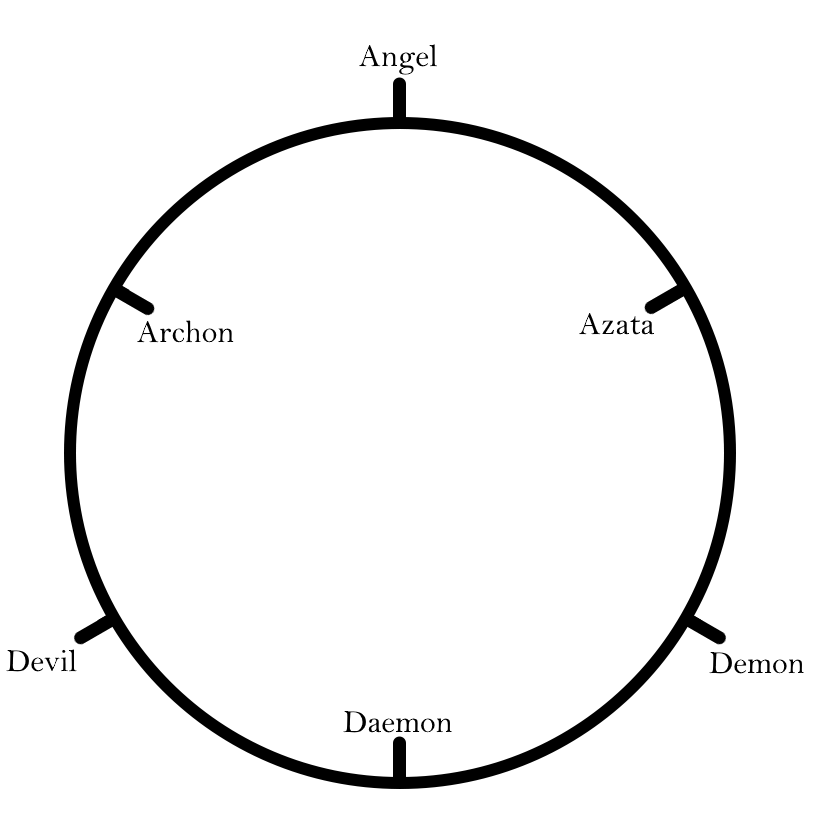 are slightly different: they embody their Principle with their whole being, often to excess and extreme. Angels, devils, and demons with similar Principles can coexist well, but even those of the same sort inevitably clash if their Principles differ strongly.
Archons, azatas, and daemons exist within the setting, but are more like subtypes of other celestial beings. Celestial beings by-and-large can be divided into three categories that cover the edges of a tri-pointed but circular continuum, with archons, azatas, and daemons falling into the space between. Archons are the space between angels and devils, azatas are the space between angels and demons, and daemons are the space between devils and demons. Celestial beings can exist at any point on the continuum with individualistic differences between each, but the three major categorizations - angels, devils, demons - are where most are clustered.
Nephilim
Celestials and fiends tend to view mortals as inconsistent, dishonest, inauthentic; mortals are free to betray their true beliefs and often do so for a variety of reasons. On the other hand, most mortals would view celestials and fiends as insufferably pure and honest to a fault, often calling them impractical or inflexible. Nephilim are inevitably stuck between these two worlds, their souls a solid in-between point for these two approaches to the world. Most nephilim end up living their whole lives frustrated at the lack of authenticity in others around them, often having a hard time navigating nuanced social situations as a result. Nephilim inevitably find community with others who fight for their right to be themselves, which often includes plenty of other nephilim given the superstition surrounding the ancestry.
Atris (they/them)
Once the god of heroic battle and conquest, Atris (ah-treess) faced a reckoning following their direct part in the Cascade - and the fact that their precepts had, in their eyes, been the direct cause of the event. Those rumors that survive from before the modern era tell of Atris as a god of war who charged headfirst into combat without risk, all in the pursuit of justice and glory. That changed abruptly after the Shattering of the first layer, an event which caused Atris to seriously reevaluate their place in the world.
Atris now claims no title, though those who know of them would most likely call them the god of repentance and redemption, possibly adding introspection and meditative reflection to that list. They dedicate themselves to repairing the damage caused by their past conflicts, remaining adjacent to or within the first layer to this very day.
Most depictions of Atris are from pre-modern times and therefore are shown in their old fashion: a warrior with long hair atop a charging horse, sword outstretched and mouth open in a war cry. Even among those who know of the god's continued existence, there is little broad consensus on their modern depiction.
Myths & Legends of Atris
Few myths of Atris survive to the present day, as the god is unknown to all but the longest-lived peoples outside of the plane of Aether. Those that do are mostly about historic battles from before modern memory, though there are whispers that the angels occasionally spotted in the skies of the Aether may have some relation.
Aetheric tribes are more likely to know of Atris as the only known god involved in the Cascade or the Shattering, referring to their unnamed opponent as the Adversary.
Iela (she/her)
Within the whipping winds and sheer cold of a blizzard, Iela (eye-ell-uh) sits within a cabin, offering shelter, warmth, and sustenance. The goddess of ice and snow but also perseverance against hardship, Iela has special favor among those dwelling within colder climates, and in the past she did her utmost to protect and provide for those who braved harsh weather every day, cold and warm alike. In recent years, however, she has proven unresponsive on the Mortal Plane except to her chosen champions and clerics, leading many within this plane to lose faith.
Iela is generally depicted as a woman with a soft smile and arms outstretched, often with a blanket over one arm or a warm mug in one hand. She is sometimes confused with Mephine in certain areas.
Iela Worship Within Sheora (on the Mortal Plane)
Within the country of Sheora, the cult of Iela has been twisted into something that represents nationalism and imperialism: a cold protector and warrior, enforcing law and wielding the winds of winter as her weapon. Despite the fact that this depiction differs substantially from the Iela of fact, for some reason, the prayers of her Sheoran worshippers are still sometimes answered, and somehow clerics and champions are able to wield power. Some suspect that another entity is answering these prayers, but if that is the case, the details of that entity are unknown.
Myths & Legends of Iela
Iela and her complementary opposite, Kratune, are often depicted in a relationship with one another. Whether or not this is factual is known only to the gods.
Kratune (he/him)
Kratune (krah-toon) is often thought of as a god of destruction. As a god of storms and other similar natural events - volcanic eruptions, landslides, earthquakes, tidal waves - this might seem logical, but Kratune's place in the pantheon is much more nuanced than that. This god represents the extremes of the natural world: not only its destructive power, but also its beauty. Kratune is known as a deity of extremes in a similar manner, and many translate that into reverence of Kratune as an icon of passion and drive.
Kratune is generally depicted as a stone-faced man with an angular jaw, often with representations of natural extremes substituted for parts of his body (overflowing lava from a volcano's mouth for hair, a thundercloud for a beard, etc).
Myths & Legends of Kratune
Kratune and his complementary opposite, Iela, are often depicted in a relationship with one another. Whether or not this is factual is known only to the gods.
Mephine (she/her)
Resting adjacent to the lowest layer of the Firmament, the Void, Mephine (meh-feen) is the goddess of solitude and respite. Many of the souls of the departed find their final rest in Mephine's domain, and she is happy to provide them the comfort they need. Some see her as a bringer of death, but the more common view is that she serves the duty of protecting the souls of the fallen from unwanted intrusion, escorting them to where they can be comfortable and safeguarding them for eternity.
Mephine is a friend to those seeking quiet solace, and to those to whom the world dealt an unfair hand. In their passing, Mephine is said to stay with them personally until they can be at peace, and some legends even state that Mephine gathers kindred spirits together so that solace does not turn into loneliness.
Mephine is commonly depicted as a woman with a shadow-cloaked face, wearing loose robes that cover her whole body. Often, she's shown cradling or holding an infant or some other representation of a lost soul.
Myths & Legends of Mephine
A particular legend of Mephine states that the goddess ascended at the moment that her son died after a lifetime of illness, growing to godhood for the specific purpose of guiding him to sanctuary.
Miorr (he/him)
Said to be the twin of Atris, Miorr is the protector of the weary, defender of home and hearth, and champion of all who find themselves fighting to protect those they love. More than any other god, Miorr has been known to flaunt the tendency of deific non-interference, regularly sending an avatar to fight on battlefields consistent with his principles when he can.
Miorr is always depicted with armor, a weapon, and a shield, but the shield is always stretched out in front: a symbol of the god's drive to protect, not to aggrieve.
Myths & Legends of Miorr
Miorr is said to have stood to protect the peoples of the Aether on the day of the Cascade, standing between his sibling and their unknown adversary. It is also tradition to many surviving Aetheric tribes that Miorr is the only reason that they survived, personally shielding those he could from harm.
Xyies (they/she)
One of the more esoteric deities of the planes, Xyies (shyee-es) is undeniably a god but hard for most to specify. Xyies is one of the beings known to wander the Staircase: the sixth layer of the world, filled with impossible geometry that overlaps with itself. It is said that Xyies is a truth-seeker, a detective set on unraveling the deepest mysteries of the universe, and stops at nothing in order to do so. One must be truly intriguing to draw the special attention of Xyies, but plenty still turn to the god in search of answers, and they do occasionally provide them if it suits her.
Xyies is rarely depicted more than in mystery symbolism, and it is said that those who encounter Xyies do not tend to realize they are speaking to a god until long after, if at all.
Myths & Legends of Xyies
Yotz (he/they)
Yotz (yohtz) is the god who travels the planes out of an unending wanderlust, searching for whatever adventure or excitement they can stick their nose into. He's the patron of explorers and travelers just as much as he is the patron of nomadic peoples; gnomes often have an exceptional fondness for him as a result, and he's been known to show up as a guest to fey and gnomish parties on many a plane.
Most know that Yotz demands no formal worship, just that they show favor to kindred spirits. When statues or shrines to Yotz are constructed, the variations are as different as the planes, but all include the wide-mouthed toothy grin characteristic of the god.
Myths & Legends of Yotz
Other Faiths, Cults, and Powerful Beings
Cascadism
Cascadism is a faith and spiritual practice primarily found on the demiplane of Gracetear, though ratfolk and even some catfolk and strix have carried it beyond. Cascadism, formed in the wake of the Cascade, preaches the self-sufficiency of mortals independent of any deity through principles of broad community, shared faith in neighboring peoples (and spiritual practice), and the value of individual cultures. It values community leaders for what they bring to the community rather than for any personal virtue, and it places particular faith in the concept of divine energy created by people acting in community. Given the success it has had at empowering religious and communal leaders with divine power, Cascadism shows merit, though its limited reach has thus far ensured that most planes remain locked to traditional worship of the divine. Followers of Cascadism strive to hold themselves to high standards not out of arbitrary morality judgement but out of desire to become pillars of the community who uplift those around them, though this can sometimes lead others to view them as inauthentic.
Melitta (she/her)
Some across the planes report having encountered a godlike being: a young woman with green hair that hangs down like pine needles, eyes the brown of fertile soil. Melitta's (meh-lit-uh) power is said to be unmatched by any mortal, and she's been known to provide blessings that have turned unusable land into that which is suitable to sustain growth for generations. Some call her the god of nature, growth, and agriculture, yet she herself does not claim a godly title, and she seems to have few if any champions or clerics, let alone worshippers.
Tiotl (she/her)
Tiotl (tee-oh-tl) is a mysterious figure who shows up in legend and myth aplenty, yet rarely with any substantive or consistent detail. Some call her a god of blood and death, others a god of love and passion. Some say that she's a hero who fought for those she cared about, others that she was a villain who caused the death of thousands. Others even say that she was the unknown second party in the Cascade, or that she was an ancient god who the modern pantheon banded together to dethrone. It's been said that she now dwells somewhere on the Mortal Plane, as well as that she was destroyed to such a degree that only fragments of her remain. What is known is that Tiotl is worshipped almost nowhere, and that those to whom she grants power are so rare as to be near-mythical themselves.
No Comments